
In real life, vibration almost never operates alone. Factors like temperature, electrical load, humidity, corrosion, and packaging stresses interact in fundamental ways.
Shifting from a single-stressor mindset to an interaction-based one is essential for meaningful reliability testing. Reliability depends on stress interaction, not isolation.
Why Combined Environments Matter
When investigating a field failure, it is rare to find a single isolated cause. More likely, vibration initiates the damage, temperature propagates it, and moisture or electrical bias turns it into a functional failure.
Single-environment vibration tests have a necessary place in product development. Engineers run vibration tests to isolate specific conditions, validate results against standards, and replicate known operating environments. They offer clarity, repeatability, and comparability across design iterations.
For reliability testing, engineers often supplement single-environment tests with combined approaches to best capture real-world stresses. These broader strategies build upon foundational vibration tests to improve confidence in long-term performance.
Combined environment testing exists because many failure modes simply do not activate unless stresses overlap. If a test does not preserve these overlaps, it may pass in the lab and fail in service.
Single-environment Vibration Testing
- Validating results against a standard or requirement
- Replicating a known operating condition
- Isolating a failure mechanism or resonance
- Performing controlled comparisons between design iterations
- Correlating lab results to field measurements
- Supporting root-cause analysis
- Verifying performance under worst-case or boundary conditions
Multi-environment Testing
- Simulating a product’s lifecycle across varying conditions
- Improving confidence in long-term reliability and durability
- Capturing interactions between different environments
- Reducing risk of missed failure modes
- Representing real-world variability more accurately
Overview of Combined Environments
Combined environment tests do not always apply every stress simultaneously. In practice, engineers apply stresses in a way that preserves their interaction. Common stress combinations include vibration, temperature, humidity, and electrical load.
Sometimes, the interaction is simultaneous, such as vibration during a thermal ramp. Other times, it is sequential but tightly coupled, such as vibration immediately following condensation.
Damage accumulates because stresses interact in time, space, and material response. The goal is to replicate real conditions, and many failure modes require stress interaction to initiate or propagate.
Common Test Sequences
Test planning should begin by asking: which stresses coexist in the field and how do they overlap in time?
Transportation electronics almost always experience vibration combined with thermal cycling. Power electronics add an electrical load and internal heating. Outdoor and industrial products involve humidity, contaminants, and corrosion. These interactions are not arbitrary, and a design analysis should reflect them.
- Vibration + thermal cycling: electronics, automotive, aerospace
- Power cycling during vibration: inverters, PCBs, batteries
- Humidity + vibration: connectors, seals, outdoor systems
- Salt + temperature: corrosion + thermal material stresses
Sequential vs. Simultaneous Testing
Deciding between a sequential or a simultaneous test flow is one of the most critical decisions in combined environment testing. If a failure mechanism requires two simultaneous stresses, such as vibration-driven fretting in the presence of humidity, sequential testing may never trigger it.
Sequential testing can be appropriate when stresses are largely independent or when equipment constraints exist. The danger is assuming sequential testing is always “good enough.” Field data and design analysis should guide this decision, not convenience. A shortcut can hide failure mechanisms.
- Simultaneous testing: Required when stresses strongly interact
- Sequential testing: Acceptable when interactions are weak
Linking Combined Tests to Real Environments
Combined environment tests should always reflect field stresses. If a product faces vibration, temperature cycles, electrical load, mechanical cycling, and humidity in the field, then the tests should reflect that reality. This action can reduce over-testing—i.e., time wasted—and prevent under-testing and, subsequently, failures in the field.
Field measurements, especially vibration and temperature data, help engineers build a test with justified severity. The goal is not to perfectly recreate the field environment but to recreate equivalent damage potential in a defensible way.
Incorporating VR Products
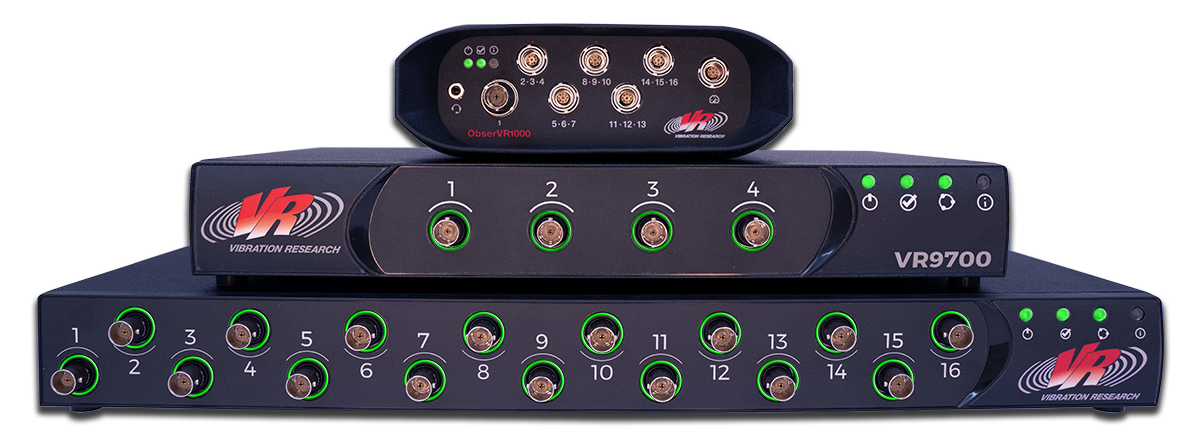 Vibration Research’s controllers are compatible with any electrodynamic or servo-hydraulic shaker. They work with existing lab infrastructure, new or legacy.
Engineers can use the remote terminals to connect the controller to the operator station pushbuttons. Alternatively, they can integrate the controller with the chamber.
Additional features such as test sequencing, limits/aborts, and automation help coordinate test setups and control combined environments safely.