
Many product failures do not come from operation, but from logistics. The shipping environment differs from the operational one in both how vibration is generated and how damage occurs.
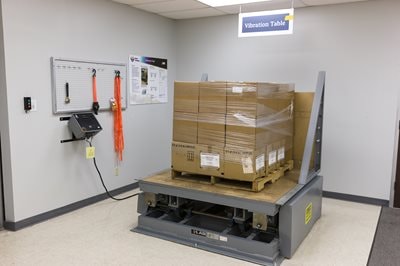
The significance of transport vibration is largely underestimated. Engineers often falsely assume that shipping vibration is less severe because the product is off and protected by dunnage. However, shipping can be more damaging than the end-use application, especially when packaging unintentionally amplifies certain frequencies.
Engineers must include the shipping environment in their testing plan to avoid unintended product fatigue or damage.
The Shipping Environment
During shipping, vibration is driven primarily by vehicle-road interactions rather than a controlled or continuous mechanical source. Damage mechanisms may include repeated low-level inputs, occasional high-impact events, or resonances introduced by the packaging system.
For example, a truck traveling over expansion joints or rough pavement produces broadband random vibration. Events such as potholes or loading impacts introduce intermittent shocks.
Unlike fixed shaker mounting, shipping conditions vary, leading to changing boundary conditions throughout transit. This creates a variable environment where both repeated vibration cycles and transient events contribute to damage.
Additional Considerations
Packaging also alters how energy is transmitted to the product.
Cushioning materials can shift system resonances or amplify certain responses. A classic example is overly stiff packaging. If the cushioning system shifts the package’s resonance into a high-energy section of the truck or rail vibration spectrum, it can increase stress on the product compared to free-mounted conditions.
Dunnage interactions also increase the risk of damage. Products rarely vibrate in isolation during shipment. Contact points, preload, and friction can create resonances that are not present during standalone lab testing.
Orientation is another critical consideration. A product shipped on its side may experience different load paths through fasteners, solder joints, or connectors than it experiences in operation.
Transport Vibration Testing
Shipping standards, such as ISTA and ASTM D4169, do not cover every possible shipment. Instead, they define statistical distributions and duty cycles because shipping damage is not deterministic.
Shipping and durability failures are driven by variability. Engineers require statistical methods to determine how much testing is enough, how to interpret failures, and how many samples to test.
Common Standards
- ISTA 1–3 series (distribution simulation)
- ASTM D4169 (DC levels, truck profiles)
- MIL-STD-810 (transportation, handling)
- ISO 13355 / ISO 2247 (packaging vibration and drop)
Considerations
Transport vibration tests must include the complete packaging system. Testing the device under test (DUT) alone omits dominant contributors to fatigue damage.
Environmental factors such as temperature and humidity can also affect packaging performance. Foam stiffness, damping, and compression can change over time, altering how vibration is transmitted to the DUT. Additionally, repeated handling events introduce cumulative damage that may not be captured in a single test segment.
Engineers should account for this variability when defining test durations, sequences, and profiles so that the lab test reflects the range of conditions encountered during shipment.
Field-to-lab Workflows
Transport vibration highlights the importance of measuring field data. Engineers can use vibration data from trucks, rail, air, or sea to build realistic test profiles rather than relying solely on generic spectra. Field-to-lab workflows help confirm that you are testing the right environment at the right severity.
The following paper outlines a process for establishing a valid comparison between real-world data and a shipping test specification.